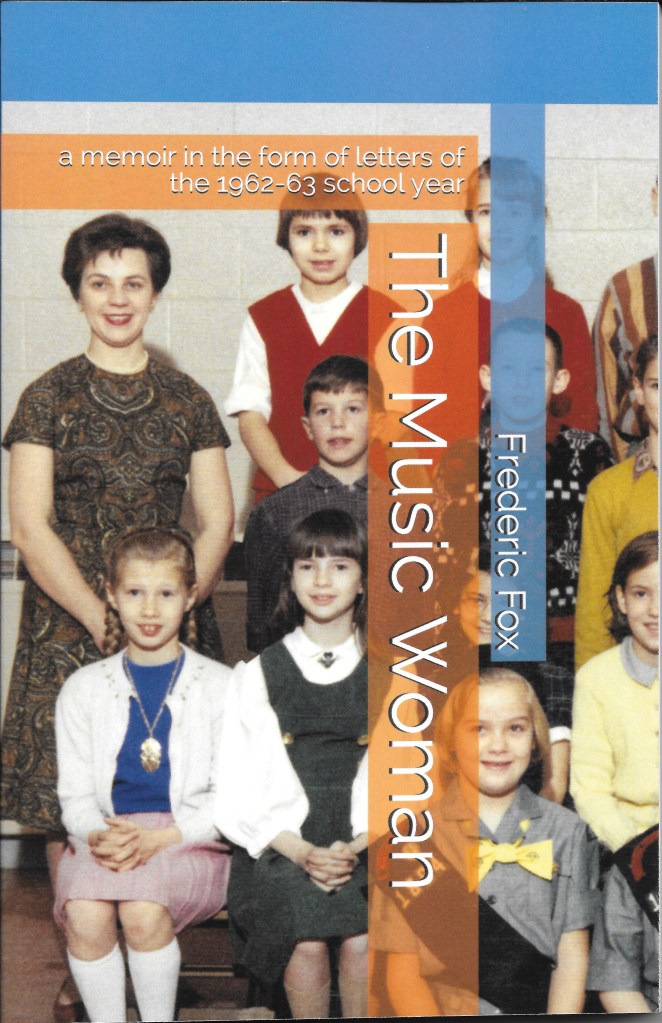
The Music Woman
The folk songs — American and World — taught by a Fifth Grade teacher at the Chevy Chase, Maryland elementary school in 1962-63 are preserved in letters written by former White House aide, Frederic E. Fox to his mother and to his wife over the school year. Frederic E. Fox died in 1981, but these letters are part of his papers in the Eisenhower Presidential Library in Abilene, Kansas. “The Music Woman” of the title was the 5th grade teacher of the editor. This is a book of both music and American history — and of one year in the life of an American family 57 years ago.

One Thousand and One Morning Prayers
This book has only two chapters. The first is “Prayers in Covid-19 Time.” The second is “Prayers in Ordinary Time.” The prayers in Covid-19 Time begin in March 2020 and conclude in September, as that is the month the author retired as a hospital chaplain. The prayers in ordinary time start in March 2005 and end in March 2020. The prayers are expressions of both religion in medicine and of humanities in medicine. Mayo Clinic Health System — Franciscan Healthcare’s tradition of a public morning prayer dates back to the founding of the hospital by the Franciscan Sisters of Perpetual Adoration in 1883. These prayers, by a Protestant pastor who ministered for three years in Italy, carry on this tradition.
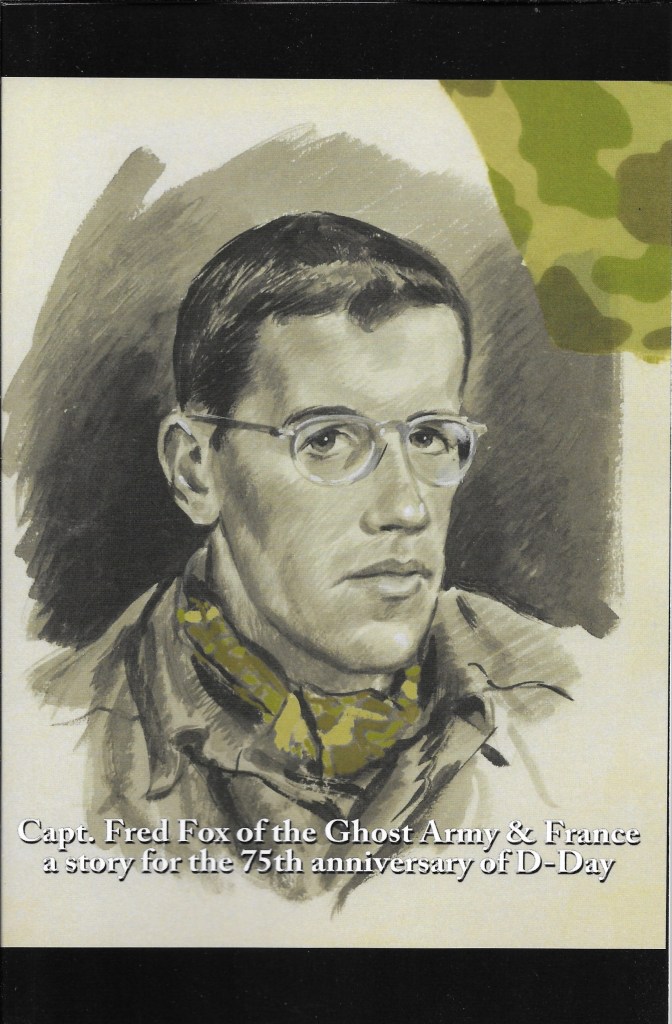
Capt. Fred Fox of the Ghost Army & France: a story for the 75th anniversary of D-Day
Capt. Fred Fox wrote the history of the Ghost Army but did not live long enough to tell the story of his service in this unique unit of the U.S. Army in the European theater during World War II. In this little book of 100 pages, Capt. Fox tells his story through his letters home. The book is full of human interest, giving one soldier’s experiences in France in those vital months of June, July, August and half of September 1944.

The Happiest Boy in the World
This book captures the mood of one’s last year in high school, a time when one is an eager student both of oneself and the abundant amount of stuff, from books, plays and songs to family and interpersonal relationships, that is thrown at you. And with the school year 1969-1970 ending with the Invasion of Cambodia, Kent State, a March on Washington, and strikes at both Princeton University and Princeton High School, there is a heightened sense of awareness. The novel is about education, first love, and the Kierkegaardian theme of “possibility.” It can perhaps best be summed up in a line by the French author Paul Valery: “What one hoped to have happened in ‘Year Y’ would be much more important to know for giving us a conception of that year than all the facts that one could gather under that date.” As the title announces, it is also about happiness — an ever popular subject and goal of life.

The Happiest College in the World
This novel takes place during a slice of American and Canadian history — from September 1970 to January 1975. It starts in Montreal and “The Troubles” occasioned by the kidnapping of James Cross and Pierre Laporte by the Federation for the Liberation of Quebec in October 1970. This causes the central figure of this novel-in-the-form-of-letters to drop out of McGill University and return to his hometown of Princeton, New Jersey. In the fall of 1971, the scene changes to the city of Three Rivers (Trois-Rivieres), Quebec where the protagonist and four other American friends re-start their college education at the two-year old University there. With its openness and friendliness, the University of Quebec at Trois-Rivieres becomes “The Happiest College in the World.” Its theatre and musical departments stage an operetta by Jacques Offenbach every semester. As basketball was invented by a McGill graduate, the young University in Trois-Rivieres develops into a small powerhouse in that sport. As Trois-Rivieres is the sister city of Tours, France, the University establishes a summer semester there which the protagonist takes advantage of and greatly enjoys. The novel concludes with the vision of a joint publishing effort between Trois-Rivieres, Princeton and Paris. As well as telling the story of the college education of a few students in the first half of the decade of the ’70s, the novel also details the life of the family of Rev. Dr. Frederic E. Fox, the Recording Secretary of Princeton University who was a great letter writer. The novel then can be seen as something like a prelude to the biography of Frederic E. Fox, published in 2016, entitled “The Old Familiar Places, the Life and Letters of Frederic E. Fox, the Spirit of Princeton.”
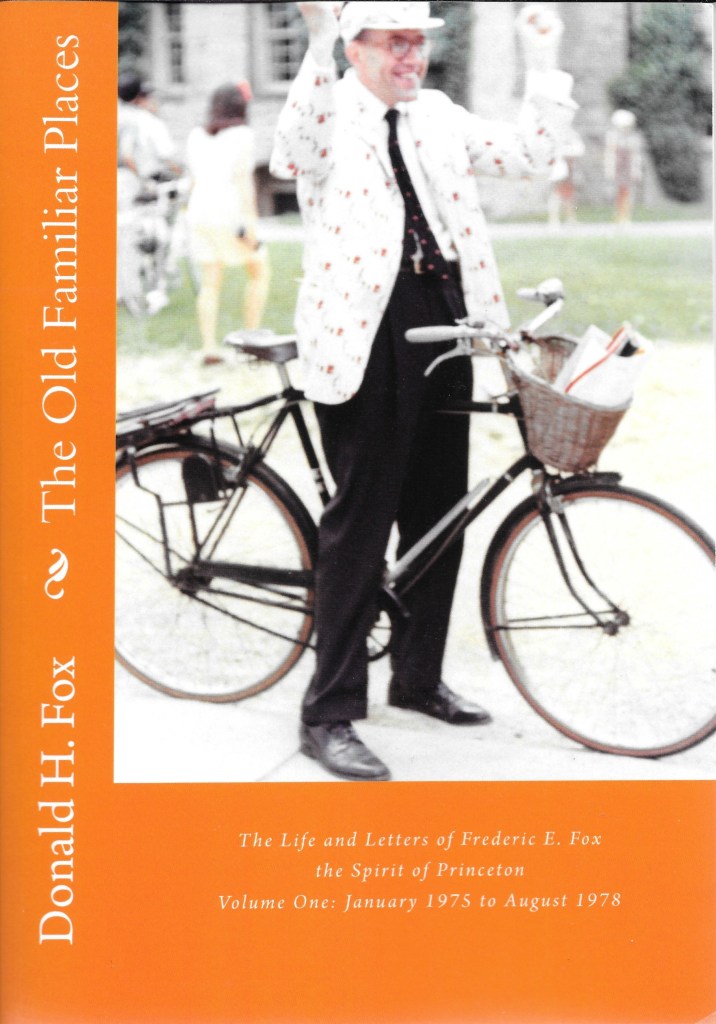
The Old Familiar Places: The Life and Letters of Frederic E. Fox, Volume One
This is a two-volume biography, a “Life and Letters” of Frederic E. Fox, the “Keeper of Princetoniana” at Princeton University. Fox graduated from Princeton in 1939. He returned twenty-five years later to the campus he loved. He served Princeton University at a pivotal period of its history: when it changed from an all-male, relatively homogeneous school to the co-educational, diverse institution it is today. He was a tireless champion of the idea of the university. He was often called “Mr. Princeton” but he knew he had counterparts among hundreds of thousands of students across the world who feel a loyalty, an old-fashioned devotion to their alma mater. The “Old Familiar Places” of this biography are mostly all in and around Princeton, New Jersey but they celebrate something universal — the connection between the place where we were educated and our emotional lives. He once wrote to a student who had mixed feelings about graduating in this way: “No one can forget this place, the various brothers and sisters we met here. (Also the various aunts and uncles.) Those of us who don’t move on, we who hang around the place and try to keep it going, we too have a feeling for it. While our household sometimes erupts in one way or another, fights in the kitchen, skeletons in the closet, we’re grateful that it still goes on. The ties are fragile, as fragile as memory and promise, but I prefer it that way. In the long run, I think it is stronger than any ironbound community. Show me a better place on this earth.” The second theme of this “Life and Letters” is Fox’s love for his family. He is an example of someone who achieved a rare balance between his professional life and his personal life. This balance — it could be called “happiness” — makes Fox an interesting and helpful character to learn about. He has something to share, perhaps to teach, about the popular, though elusive subject of happiness. During the three years that Fox’s oldest son was in the Peace Corps, Fox wrote him every week. During almost every week of the academic year, Fox wrote a column for Princeton’s weekly alumni magazine. This column was a chronicle of the life and times of his classmates. This “Life and Letters” paints a vivid portrait of Fox over the last six years of his life and as it does, it also documents the “Life and Times” of America from 1975 to 1981.

The Old Familiar Places: The Life and Letters of Frederic E. Fox, Volume Two
This is a two-volume biography, a “Life and Letters” of Frederic E. Fox, the “Keeper of Princetoniana” at Princeton University. Fox graduated from Princeton in 1939. He returned twenty-five years later to the campus he loved. He served Princeton University at a pivotal period of its history: when it changed from an all-male, relatively homogeneous school to the co-educational, diverse institution it is today. He was a tireless champion of the idea of the university. He was often called “Mr. Princeton” but he knew he had counterparts among hundreds of thousands of students across the world who feel a loyalty, an old-fashioned devotion to their alma mater. The “Old Familiar Places” of this biography are mostly all in and around Princeton, New Jersey but they celebrate something universal — the connection between the place where we were educated and our emotional lives. He once wrote to a student who had mixed feelings about graduating in this way: “No one can forget this place, the various brothers and sisters we met here. (Also the various aunts and uncles.) Those of us who don’t move on, we who hang around the place and try to keep it going, we too have a feeling for it. While our household sometimes erupts in one way or another, fights in the kitchen, skeletons in the closet, we’re grateful that it still goes on. The ties are fragile, as fragile as memory and promise, but I prefer it that way. In the long run, I think it is stronger than any ironbound community. Show me a better place on this earth.”
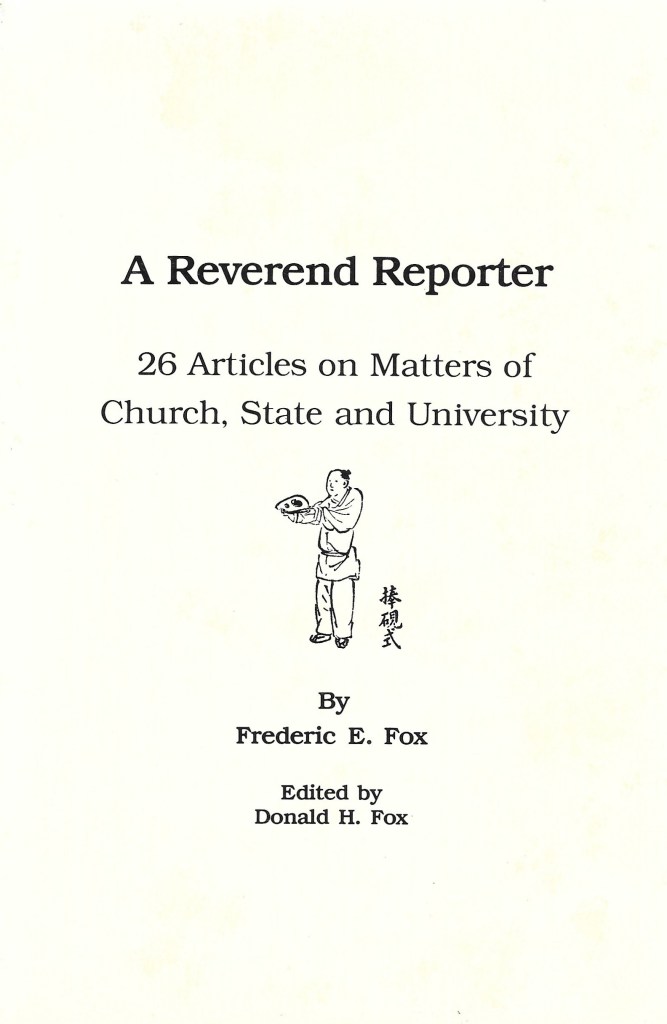
This book collects the magazine articles, etc, etc.
Dr. Frederic Fox’s Princeton Chapel sermons are collected here …
The story of a romance and an engagement ….
The chronicle of the death of one’s father is …
 foxheadpress